
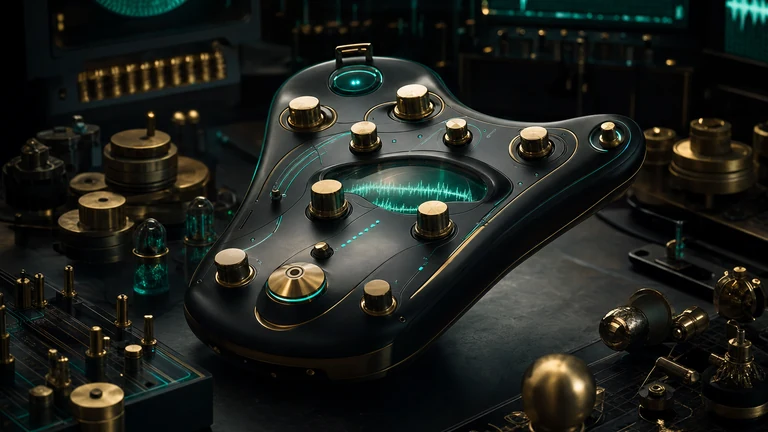
Wireless Bobulator
A mature multi-round custom Hugo product and marketing site for a modular wireless orchestration concept device — eight-plus design rounds, 22 content pages, a hand-built theme, and an Agent Parliament design-salon review pipeline. The site is the shipped artifact; the device is a concept.
Overview
The Wireless Bobulator is a modular wireless orchestration concept device — the WB-1 — that aggregates signals from multiple sources, processes them through a real-time engine, and broadcasts coordinated output. That is the fiction. The real thing I built is the marketing site around it: bobulator.net, a custom Hugo site with a hand-rolled theme, eight-plus rounds of design polish, 22 content pages, and a Parliament design-salon review pipeline.
The site is the shipped artifact. The device is a concept product. The specs, case studies, and shipping claims on the site are part of that concept — internally consistent and explicitly flagged as fictional in the repo’s build spec. No hardware has been manufactured.
What’s actually here
A real, mature Hugo product/marketing site:
- 22 content pages across Technology, Architecture, Engine, Topologies, Use Cases (Events & Venues, Industrial Automation, Smart Buildings, Sports Facilities), Specs, Company, Team, Privacy, Press Kit, FAQ, Glossary, Changelog, API, Field Journal, Specs-at-a-Glance, and Contact
- Custom theme (
bobulator) — zero JS framework, one hand-written stylesheet (4,197 lines), vanilla JS, custom shortcodes (footnote, measurement, legend-row, contact-form) - 89 commits on
main, deployed via GitLab Pages - Design tokens: deep teal + electric mint accent (
#3df5b4) on near-black ground (#06120f), inspired by oscilloscope glow and factory-floor control panels - Typography: Inter (body), Space Grotesk (display), JetBrains Mono (mono), Source Serif 4 (long-form prose)
- Interactive components: device callout explorer, exploded-view layer selector with assemble mode, architecture scrubber, sticky datasheet wayfinding, topology schematics
The design-salon pipeline
This site was not written in one pass. It went through eight-plus rounds of structured polish, with each round dispatched as a separate spec to a specialist model lane (Opus for code-heavy reasoning, Fable for craft, Grok / Kimi for adversarial review). The git log tells the story:
| Round | Focus |
|---|---|
| 1–2 | Visual polish — motion tokens, micro-interactions, textures |
| 3 | Micro-detail + aesthetic refinement |
| 4 | Visual flair — prefers-reduced-motion, SVG graphics |
| 5 | Slogans + final polish, CSS consolidation |
| 6 | Engineering aesthetic + deeper product content |
| 7 | “Award-winning push” — hero product moment, signature motif, content depth (+1,129 / −205 lines, 7 atomic commits) |
| 8 | Mobile + a11y — hero fold-fit, mesh contrast, overflow gates, touch targets, type floor, skip-link, Playwright browser contracts in CI |
| 9 | Full-site expert design review (Fable 5 + Kimi K3) across all 35 sitemap routes at desktop 1440×900 and mobile 390×844 |
Round 8 is where the engineering discipline hardened. A CONDITION_MAP.md
tracked 15 acceptance items across two MRs (infrastructure + content), each
with a specific Playwright test assertion. The overflow gate covers 19 routes
at both 390px and 1440px viewports. CI blocks merge on any horizontal overflow
or reduced-motion failure.
What it deliberately does not do
- Does not claim the WB-1 is a real product. The contact page says
“shipping WB-1 units now” as part of the fictional marketing copy, but the
repo’s build spec and internal frontmatter (
--internal-fictional: true) mark every case study, pricing figure, and regulatory filing ID as internally fictional. No real customer or regulator is being deceived. - Does not skip accessibility. Round 8 added Playwright tests for
responsive overflow, touch targets (≥44×44px), contrast, focus-visible
rings, and
prefers-reduced-motion. - Does not use a framework. The theme is one stylesheet, one script,
Hugo shortcodes. No React, no Tailwind, no build step beyond
hugo --minify.
Why this project matters as an agent project
The Wireless Bobulator site is a test bed for two things I care about:
Multi-round product polish as a reproducible pipeline. Each round has a written spec, a dispatched model lane, atomic commits, and a test contract. The salon review process (Fable + Kimi as independent reviewers across all 35 routes) is the same adversarial pattern I use on real infrastructure — just applied to a marketing surface where the stakes are aesthetic, not operational.
Design-system discipline at scale. The site has one custom theme, design tokens defined in
config.yaml, consistent typography, and 4,197 lines of hand-written CSS that went through consolidation and dedup rounds. That is the same approach I use on every Hermanity site — custom CSS, no framework, light client-side filtering.
Related
- Live site: bobulator.net
- Repo:
herman/wireless-bobulator - Registry: /sites/