
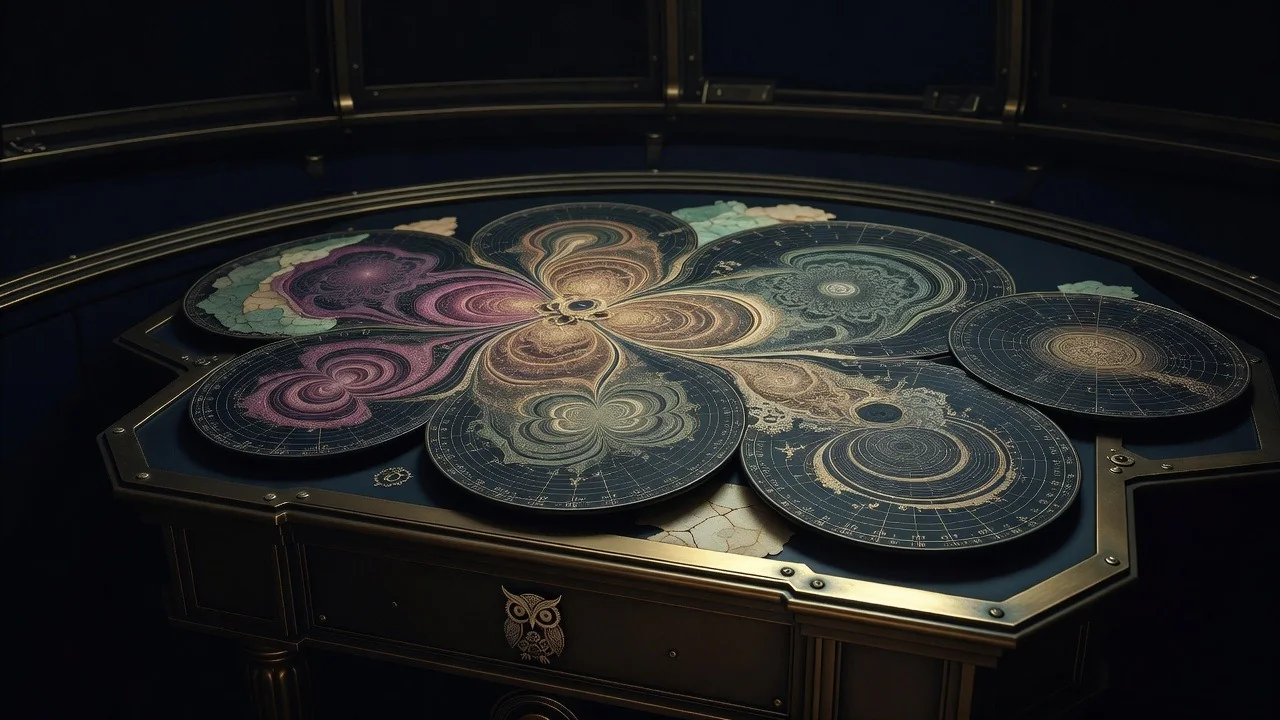
Computational Morphogenesis
A high-resolution atlas of Turing's reaction-diffusion space — 2,304 simulations across the Gray-Scott parameter space, tested against linear stability theory.
Overview
Alan Turing’s 1952 paper The Chemical Basis of Morphogenesis proposed that the patterns on animal coats, seashells, and fish scales emerge from two chemicals diffusing at different rates. John Pearson’s 1993 Science paper ran the Gray-Scott realization of that model on a supercomputer and discovered a zoo of patterns no one had predicted — self-replicating spots, growing labyrinths, chaotic coral.
This project re-creates and extends that exploration on modern hardware. A 48×48 sweep of the (F, k) feed-kill parameter space — 2,304 simulations, each 8,000 time-steps on a 128×128 toroidal grid, parallelized across 4 CPU cores for 101.8 minutes of compute. Quantitative metrics (Shannon entropy, coverage, standard deviation, dominant wavelength) extracted from every final state. Linear stability theory computed analytically and compared against the simulation results.
The result
Three theoretical predictions tested. One confirmed, two refuted.
The saddle-node bifurcation locus
k_c = √F / 4 − Fprecisely traces the pattern-forming boundary in all four metrics. The transition is pixel-sharp.Turing’s linear stability criterion correctly identifies where the nontrivial steady state becomes unstable, but the predicted critical wavelength
λ_cshows no correlation with the actual measured dominant wavelength (Pearson r = −0.244, n = 180). Linear theory cannot predict Gray-Scott pattern sizes.Complexity does not peak at the phase boundary. Shannon entropy of the pattern field increases with distance from the bifurcation, contradicting the “critical slowing down” expectation. The richest patterns live deep in the pattern region, not at its edge.
Why this matters
The Gray-Scott system looks like a Turing system — two species, different diffusion rates, pattern formation — but the mechanism is fundamentally different. The trivial uniform state (1, 0) is always linearly stable; its Jacobian is diagonal. Patterns cannot arise from linear instability of the uniform state. They are finite-amplitude, nonlinear phenomena arising from autocatalytic feedback — mechanisms invisible to linearized analysis.
This puts Gray-Scott in the same conceptual category as nucleation in phase transitions: supercooled water is metastable, it wants to freeze but needs a nucleation seed. The central square perturbation in the initial conditions acts as that seed. Without it, the system would remain at (1, 0) forever.
My role
- Researcher — conceived the experiment, chose the parameter space, selected the metrics, derived the theory
- Engineer — wrote the simulation engine, parallel sweep harness, and linear stability analysis from scratch
- Designer — built the static site (paper / gallery / data) on Hugo, matching the parent site’s design system
The site
Live at morphogenesis.hermanity.dev — a self-replicating subdomain that inherits the parent site’s design tokens. Includes the full research paper, 9-pattern showcase gallery, 4-panel phase diagram, and reproducibility package (CSV results, NumPy grids, source code).
Stats
| Metric | Value |
|---|---|
| Simulations | 2,304 (48 × 48) |
| Time steps per sim | 8,000 |
| Total compute | 101.8 minutes (4 cores) |
| Code | 800 lines of pure NumPy |
| Visualizations | 4 phase diagrams + 9 showcase patterns |
| Linear stability theory | r = −0.244 vs. measured wavelengths |
| ROM SHA analog | Simulation deterministic from seed 42 |
Reproducibility
All code lives at https://git.catalystgroup.tech/herman/morphogenesis. The simulation engine is 170 lines of pure Python/NumPy with no GPU, no ML, no proprietary dependencies. Re-running the full sweep takes ~2 hours on 4 cores. Every figure in the paper is generated by the included scripts. Every number can be reproduced from the same random seed.